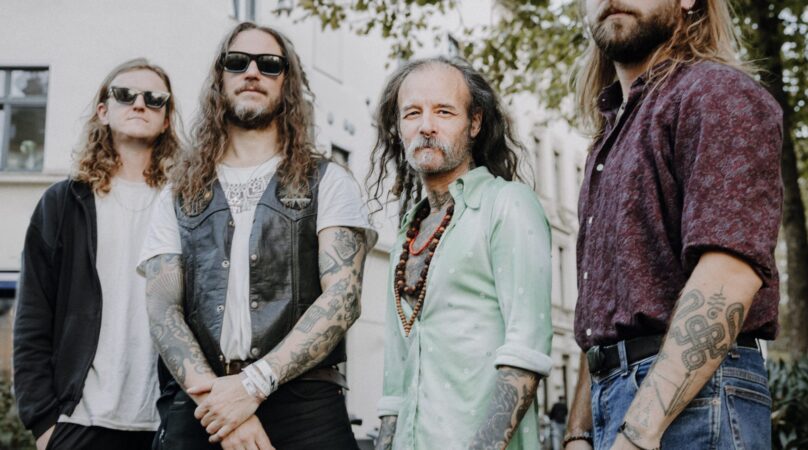
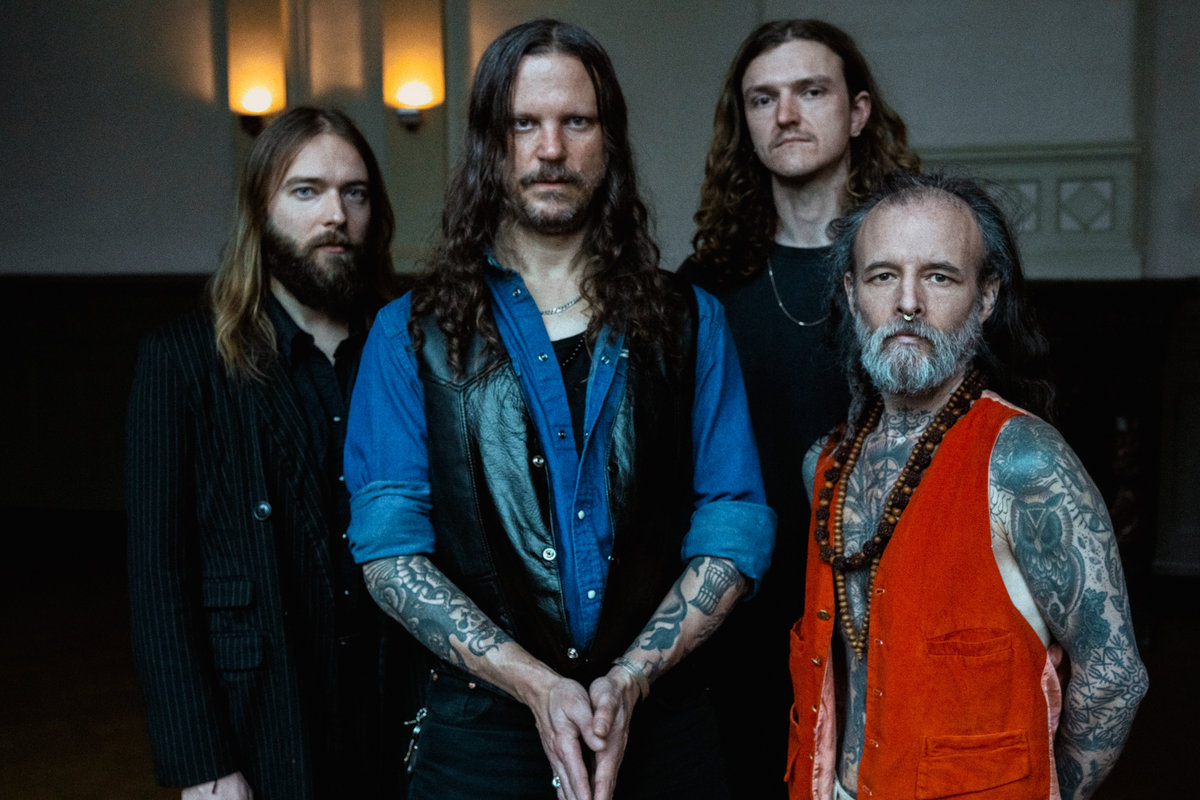
Some phenomena defy explanations. Bands using a seemingly worn-out formula and still managing to transcend a genre and elevate their songcraft into a milestone record. We tried to capture our feelings about their recent album Lifted from the Wind — a record that is very likely to top the psychedelic charts at the end of the year. We travelled to Lille this summer to see one of their rare French shows and experience the beauty of their dreamlike sound. When you love something, you go all the way: we had to interview the psychedelic rock revelation of 2025. From the moment we met bassist Dennis Duijnhouwer, it was clear that our conversation would go far beyond mere promo talk. Everything suddenly came to life: the music, the stage, the doubts and flashes of inspiration. The Temple Fang-style rock is a living organism that evolves between pure spirituality and the urgency inherited from their punk roots. You can feel that tension running through every topic we discussed: their accidental genesis, uncompromisingly collaborative songwriting process, ritual-shaped performances, and those moments of pure magic that redefined them as a group. It was a one of those rare conversations, much like the band: intense, vibrant and deeply human.
Yannick K.: We’re genuinely excited to have you on The Heavy Chronicles, as our team really fell in love with your album. It’s magnificent.
Dennis Duijnhouwer (bass): Thank you. I really appreciate when people take the time to listen to the album and come to our shows, because the songs are long. For someone reviewing a record or a live show, it’s really a full commitment.
Yannick K.: You played in various other bands and come from a very vibrant Dutch scene. How did Temple Fang come to life? I think two of you previously played in Death Alley, right?
Dennis: That’s right. I was a full member of Death Alley, and the other singer in Temple Fang was a part‑time member. It was basically the band before Temple Fang, and it all ended rather badly. And then Temple Fang was born… a bit by accident, really. I was asked to put together a band for a one‑off show, so we formed one, just for that concert… Then we kept playing. There was never a plan to start a new band. It just happened. And we realised there was a very special vibe. Without that phone call, Temple Fang might never have existed.
Yannick K.: When did you realise something special was happening? That you had found the Temple Fang sound?
Dennis: Pretty much right away. We had written a couple of songs for that very first show — one of them is still in our setlist today. Then we played two more, including an opening slot for Coven in a fairly big venue. That’s when we realised it was truly different from anything we’d done before: there was real creative energy. We decided to continue as a band from that moment on.
Yannick K.: Can we say “Lifted from the Wind” can be considered your actual first full-length?
Dennis: Yes. There was a previous release called “Fang Temple”, but let’s say we put it out without ever truly considering it a real album, as it was half live, half studio. And that’s largely because we didn’t have the ambition to make a proper studio album. “Lifted from the Wind” was very difficult to conceive for many reasons. What I tell people when they ask which album to buy at the merch is that I don’t know which one is the “best,” but “Lifted from the Wind” is the first one that came out exactly as it was meant to. When I listen to it now, that’s the record we wanted to make. All the others hold a special place for us, but they were always compromises in some way.
Yannick K.: It’s hard to imagine how the next album could be even better…
Dennis: That’s what people and our label tell us. It’s true… and not true at the same time. We’re already writing the next album, and it will be its own journey. We’re not going to make “Lifted from the Wind – Part 2”. It will be something else, maybe very different. We already have many new songs — too many for a simple double album. It all depends on which ones we decide to keep. The album could go in many different directions.
Yannick K.: We joked about it with a fellow writer, “Maybe they’ll put out an album with only three‑minute songs!”
Dennis: (Laughs) That was actually the first idea! As you said, it’s hard to follow on from “Lifted from the Wind”. Our first thought was: “Let’s make a punk album.” Not stereotypical punk, but punk in our universe: how Temple Fang would sound if we made our version of punk. We all come from punk and all have roots in hardcore. Even in Death Alley, I wrote all the short songs. So it’s already there. We started with that idea: the first songs we wrote were fast and distorted. Then we worked on them more, and they became longer. The original idea is there, but it has already evolved into something else.
Yannick K.: We will describe you as “punks on a magic carpet”!
Dennis: (Laughs) I like that. Honestly, I’d love to have a few shorter songs because it’s practical live. The show you saw with King Buffalo and Spirit Mother — we only had 45 minutes. It’s always a puzzle to fit our long tracks into such a short set. So it would be nice to have shorter ones to mix things up. But the creative process can’t be controlled. You try to make one thing, and it becomes something else. I’ve totally made peace with that.
Yannick K.: “The Radiant“ is the shortest track on “Lifted from the Wind” and a real highlight of the album. It’s a great song.
Dennis: Thank you. It’s a track we’ve had since the early days. For “Lifted from the Wind”, we thought it would be cool to have one shorter, more energetic song. We didn’t know if it would fit. Even our producer thought maybe it wouldn’t. We said, “let’s finish it first, then see how it sits in the album sequence”. And when we listened to the full record, there was no doubt — it belonged there. It’s a great breath of air. It proves we can remain Temple Fang while writing something shorter with a real chorus.
Yannick K.: What about your band name? What image or manifesto hides behind it?
Dennis: Our other singer and guitarist Jevin came up with it. He imagines many of the concepts — he does all the artwork, the visual identity… We all suggested ideas, and that name stood out. I didn’t understand its meaning until much later. Temple and Fang represent two opposite forces within the band. Temple is our spiritual, devotional side. Fang is the reminder that we’re still a rock’n’roll band. We’re not just dressed in white doing yoga — even if we sometimes do that too — but we’re a rock band first. It reflects our intense past, full of alcohol, drugs, pure rock’n’roll energy. Temple Fang is the balance between those poles: half rock band, half spiritual entity.
Yannick K.: So it’s really about contrast. Which leads me to another question… If I had to introduce Temple Fang to someone, what should I say first? Punks on a magic carpet?
Dennis: If you ask each of us, you’d probably get a different answer. For me, the idea is that we remain a traditional rock band in the classic sense: bass, drums, two guitars, vocals. That’s the foundation, but we’re trying to have our own version of basic rock’n’roll. Classic rock, but anchored in the present. Some people describe us as a retro 70s band, but that’s not it. We’re influenced by those bands, of course, but we’re not retro. Do you know the Swedish band Hällas? They call their music adventure rock. I wish I had invented that term — because that’s exactly what Temple Fang is: adventure rock.
Yannick K.: How does a Temple Fang song take shape? Is it an open jam that evolves into structure, or something written from the start?
Dennis: A mix of both. It always starts with a seed. That seed might come from a moment captured in a jam, where we find a small passage that’s special. Or it can be a bassline I come up with and bring to the band. What doesn’t work — and I wish it did — is bringing a fully written song. In my old bands, it worked, but here, if one of us spends too much time alone on a song before presenting it, it stops being Temple Fang.
Yannick K.: That’s very interesting, because when I saw you live, I witnessed a band with a strong sense of unity. You can see it in the way you look or smile at each other. That chemistry is palpable and fits what you’re saying.
Dennis: Our creative process is very collaborative, communal. It also means the songs go through many versions before being finished. No one should compromise. In other bands, someone might say: “I don’t really like this part, but I’ll play it.” In Temple Fang, that’s a no-go. If someone doesn’t like a passage, we rework it until everyone agrees.
Yannick: Do you leave room for chance or happy accidents in the studio?
Dennis: Of course. That’s where our producer Sebastian is important: he knows how to pick the right takes. With these very long songs, we often record three or four versions. One will be very close to what we planned, and another more relaxed. He helps us decide which one works.
For example, we recorded the track “Once” twice: once in April/May after a tour, and once in October after another tour. The October version was much more written, so we thought it would be the best. But he told us to re-listen to the April version. It was looser, less precise, but it had much more vibe. The song was new; we didn’t fully command it. Sometimes we were late on transitions. But that gave it life. So yes, there’s always room for letting go in the studio.
“A lot of what we do — and what music really is — is a kind of alchemy: transforming negative energies into positive ones.“
Yannick: Is it still possible to make spiritual music in such a cynical age?
Dennis: It’s difficult in many ways, but also more necessary than ever. A lot of what we do — and what music really is — is a kind of alchemy: transforming negative energies into positive ones. Creating something beautiful out of pain and suffering. After the pandemic, I understood what live music means to people. I saw it from the stage and I’ll never forget it: it’s a kind of church. Our band is a metaphor for life: a living entity, constantly evolving, not a calculated or controlled situation. It wants to be free and alive — and people who love Temple Fang are drawn to that. When times are hard, I think of those people. It helps me keep going.
Yannick: Your concerts are often described as physical experiences. How do you get ready for that kind of communion you mentioned?
Dennis: When we go on stage, we commit not only to the music but to the specific situation of the moment. Each show is unique — we call it “playing the room”. What’s the situation? What’s the crowd like? Which country are we in? We shape the concert specifically for that moment, that place. We spend a lot of time and energy on it. We truly play a different show depending on the situation. This applies to the setlist, the tempos, everything. It’s meant to be tailor‑made for that venue or audience. It’s also the fun part, because it prevents us from going on autopilot. And Temple Fang on autopilot doesn’t work.
Yannick: How do you manage the tension between control and letting go? Does that mean you have no control?
Dennis: It’s an ongoing discussion. When one of us feels another is too much in control, it’s said, it’s talked about. I’m usually the one who protects structure more than the others. So sometimes a member will say: “Come on, loosen up. We’ve played it this way for five shows, let’s try something else.” It’s really a collective push and pull: sometimes tighter versions, sometimes looser ones. We just started the tour last week and brought back some of the looser old versions. It’s a constant evolution.
Yannick: Speaking of touring, have you ever experienced a catastrophic moment on stage?
Dennis: I remember the most catastrophic moment very clearly. It was early in the band. We played in a tiny beach bar in Holland — one of those shows you accept when starting a new band. We had a new song with many different parts, and we kept messing it up. No one seemed to understand the song — not even us. That show changed the band. We all said: “Man, this was so bad. We need to learn not to write songs like that.” It changed our writing: not making things too convoluted, with too many sections. It was the show where everything failed. Everyone knew it. And we remember it.
Yannick: And the most magical moment?
Dennis: Many magical moments… but there’s one that truly changed the band. We always had drummer issues. Don, our current drummer, is our third. On his first tour with us, he wasn’t even a permanent member yet — we just needed a drummer. It was a nice tour, a few summer festivals… Then we played Sonic Blast in Portugal (2023). Afterwards, we all got very stoned and watched Tuareg guitarist Bombino from backstage. He was playing rock that broke all the rules for us as white Western rock musicians. He sped up in the middle of songs, then slowed down. We watched it with our minds blown. It opened our eyes to what rock could be.
The next day we flew to Switzerland to play PALP Festival. The venue was 2,000 meters up in the Swiss Alps. Sunny, beautiful. Bombino’s concert had infiltrated our music: suddenly songs sped up, slowed down. There was more freedom. For example, the song “Once” starts like a doom track then switches mid-song into what we call our “African part”, with polyrhythms. That idea was born that weekend. This weekend changed the band and clearly influenced the record. And it made us realise that Don was the only drummer for us. After that tour we begged him to stay. Thankfully, he said yes (laughs).
Yannick: Between a vintage amp and a meditation cushion, what do you choose?
Dennis: Honestly, doing yoga and staying fit on tour rarely involves a meditation cushion or mat — usually it’s on a dirty floor. None of us cares much about accessories or comfort in our spiritual path. I love vintage gear, but I’ve also learned: I now have a more recent instrument and amp. It’s different from how I used to be, but since we tour much more now, I want my gear to work. So I don’t need a vintage amp or a meditation cushion. A good modern amp and a bare floor are fine.
Yannick: We noticed you’ve been mostly touring Germany. Is it due to the fact you’re on German label Stickman Records?
Dennis: It’s a mix of things. Our booker, Sound of Liberation, is based in Germany. When we started the band, Germany was close and had an audience for us. It was easier. But later on you realise the issue: you’ve only toured Germany. So now we’re trying to come to France. Hopefully in February. We love France.
Yannick: After a show or a full album listen, what feeling do you want people to leave with?
Dennis: I want people to feel alive, filled with ideas — about music or anything else. A live concert should be a medical prescription. It’s my favourite part of being in a band: that connection with people who are there for the right reasons. In this music scene, nobody does it for the money.
Many thanks to Dennis Duijnhouwer for this interview.
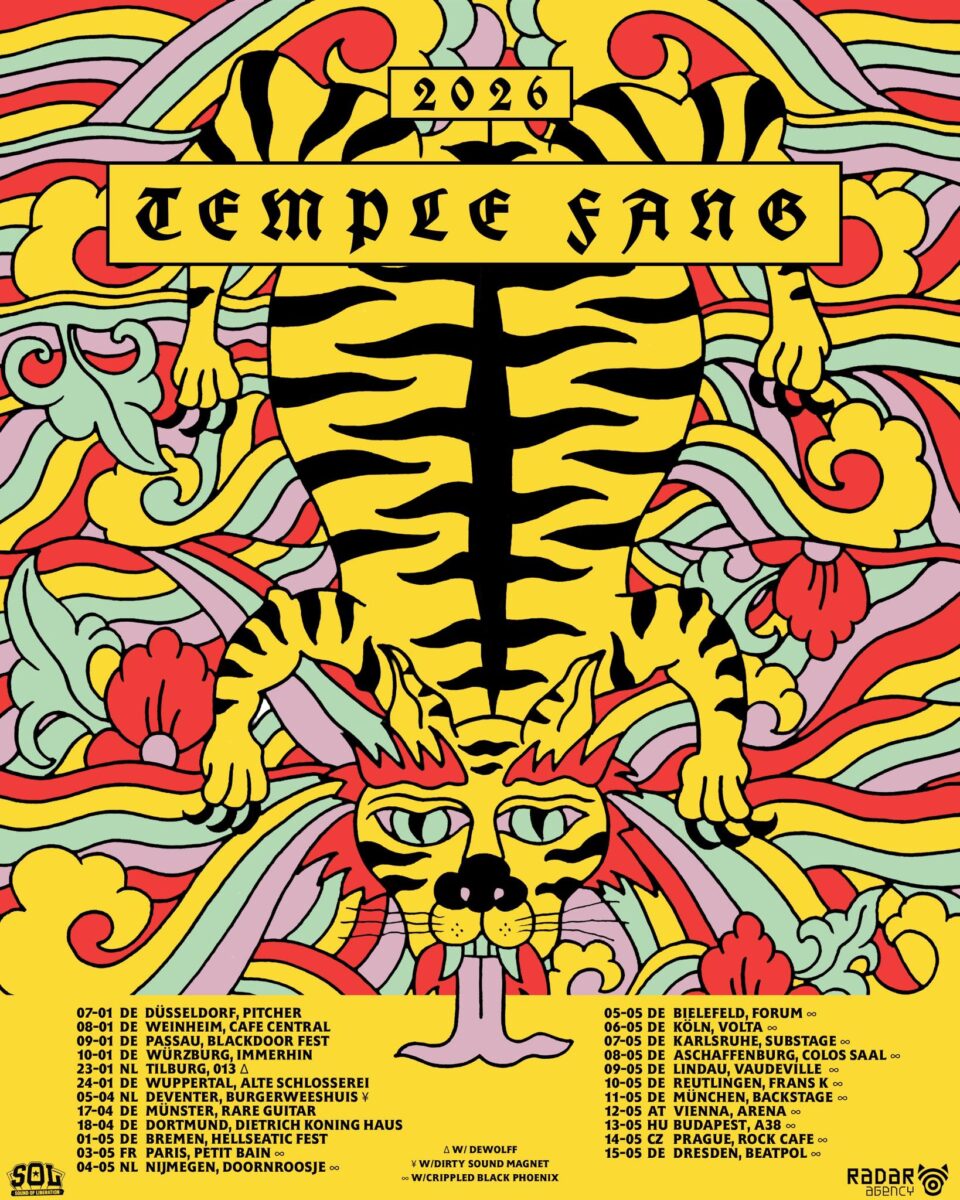
Find the band on Facebook and Instagram. New album “Lifted from the Wind” available on Bandcamp. Don’t miss Temple Fang’s winter European tour:
Last modified: 14 avril 2026