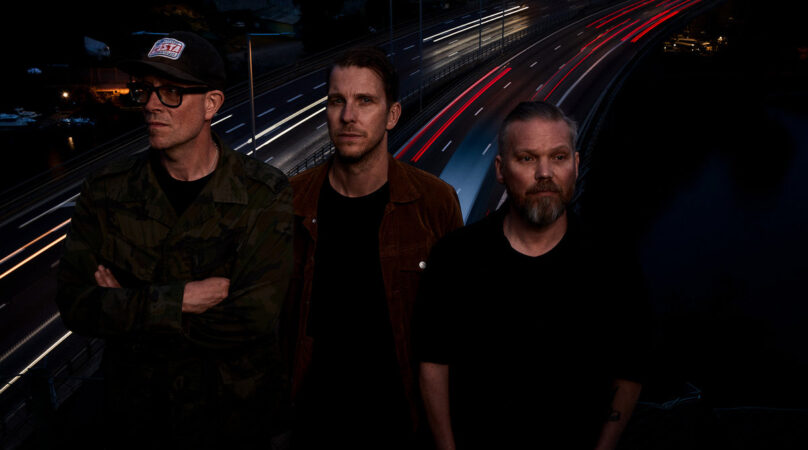
With every release, DOMKRAFT has earned unanimous praise from THC’s editorial team. Every time, everyone wants to write about them, and that’s only natural. With Night Songs, it’s finally my turn. The release of their fifth album finally gives me the chance to draw a parallel I’ve had on my mind for a long time, so it won’t be a review in the strictest sense. Expect an exploration and a visual representation built around a triptych: Seeds, Sonic Moons, Night Songs.
Since Seeds, the Swedish trio has developed a psychedelic doom-sludge sound whose scope sometimes seems to transcend the boundaries of music itself. It’s music about gravitational mass, impossible perspectives, and visions that stretch out until they make your head spin. And, as I kept searching for images to accompany these long streams of fuzz, one name eventually stood out to me: Philippe Druillet. For those unfamiliar with him, Druillet is one of the architects of psychedelic and monumental comic art. As a co-founder of Métal Hurlant, he spent much of his career shattering the boundaries of the traditional comic panel. His most beautiful panels, as if drawn while on acid, resemble extraterrestrial cathedrals suspended in the void. Colossal architectures, dizzying perspectives, hallucinatory colors, and a wealth of detail that’s almost enough to make your head spin.
Of course, this isn’t to suggest that DOMKRAFT composed their albums while leafing through Lone Sloane. But there is a rather striking aesthetic kinship between the two worlds. In Druillet’s work, the comic book page quickly ceases to be a mere narrative medium. The panels burst open, perspectives warp, and details proliferate to the point of saturation. With DOMKRAFT, the riffs sometimes seem to function in the same way.
Seeds, released in 2021, would thus be the most toxic aspect of this body of work. A sticky, venomous, almost sickening sound that unfolds like a hallucination from which one isn’t quite sure how to escape. One might find in it echoes of the worlds of Yragaël or Urm the Mad: a form of twisted psychedelia, populated by unsettling visions and mental creatures, where even color itself seems toxic. Everything seems contaminated. On the sonic hallucination front, the motifs spin, coil, and thicken until they create a sensation of confinement, verging on madness. Seeds lives up to its name. It plants something unhealthy that continues to grow in your skull long after the final note has faded.
With Sonic Moons, in 2023, the band takes things to a whole new level. The threat becomes monumental. The album possesses an absolutely boundless cosmic violence and power. The compositions take on greater scope, the riffs grow in density, and the explosions seem capable of shaking the walls of a space fortress. It brings to mind Druillet’s grand frescoes, the extravagant architecture of The Six Voyages of Lone Sloane or Délirius. The tracks rise up like cathedral-cities: you look up, but you can never see the top. Martin Widholm no longer just plays riffs—he erects pillars of sound. Anders Dahlgren’s drums serve as the foundation—massive and relentless.
And then came Night Songs. The context is obviously different: guitarist Martin Widholm went through a serious medical crisis in 2025. It was an ordeal that inevitably shook the three musicians, and the album bears the marks of that experience. Fear, uncertainty, recovery—but also relief, and the ability to rediscover joy and a normal life. Musically, DOMKRAFT seems to be seeking more light. Mind you, this isn’t about breaking out the lounge chairs and cocktails. The band retains its identity, but the compositions breathe more freely, revealing spaces and contrasts that previous albums readily crushed beneath the decibels. So it may not possess the hypnotic power of Sonic Moons or the psychedelic venom of Seeds. I find it less immediately gripping, less overwhelming in the way it fills the space.
But it would be missing the point to stop at this comparison. Here, the group explores a different, more contrasting subject matter, where moments of light do not dispel the darkness. To illustrate this new direction, I turn to Druillet’s La Nuit. An intimate and mournful work, born of his grief over the loss of his wife Nicole, who died of cancer in 1975. In Druillet’s work, the night is total, with not the slightest escape. DOMKRAFT, on the other hand, passes through its own night and emerges from it. This is where the two works both resonate with and diverge from one another. Night Songs possesses something of this fragile balance: the light does not erase the darkness.
DOMKRAFT has always taken risks with its visuals. I respect that unbridled creativity, that refusal to play by the rules. But let’s be honest: these album covers don’t live up to the music they’re supposed to accompany. A band that sounds like a Druillet comic strip deserves better. Slift understood this when they entrusted Ummon and then Ilion to the artistic vision of Caza, another big name in “comic-book-style” science fiction. The result speaks for itself: albums that appeal as much to the eyes as to the ears. A Domkraft album illustrated by Druillet—now that would be something to behold. Druillet’s imagination would have more than enough fuel to draw from the Swedes’ musical explosions.
Well, you never know. If DOMKRAFT happens to be reading this… sometimes all it takes is a bottle tossed into space.

Last modified: 17 novembre 2026