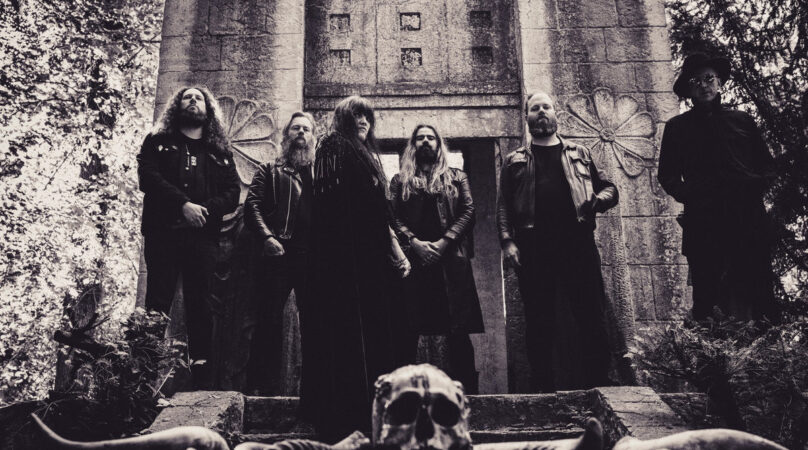
It is surprising when a band as firmly established as Wolvennest releases an album that goes beyond the radar. This discretion is puzzling, given that the demanding and monolithic “Procession” fits perfectly into the artistic vision of the shapeshifting band. Formed in the early 2010s, the Belgian collective has slowly established its distinct identity at the crossroads of doom, atmospheric black metal and ritual music — not as styles, but as tools to serve a vision. “Procession” continues this trajectory without interruption, refining an already honed aesthetic: a slow and obstinate march to which one gives in, drawn by a dark and ancient force towards the darkest territories of the band’s sonic realm.
Their previous work “Void” revealed a rawer form of tension, with more aggressive passages and its black metal-tinged energy, while “Temple” developed the hypnotic and repetitive aspect further, flirting with a form of dark psychedelia. “Procession” seems to synthesize both approaches, while further reducing dynamics and highlighting its funereal side. Everything is muffled, sepulchral, as if the music itself were disintegrating before our ears. Doom is no longer a genre: it becomes a state of prolonged decay. Wolvennest seems to refuse compromises and marches forward like an unstoppable funeral procession.
The album revolves around pronounced slowness and repetitiveness — a “slow-motion black metal” of sorts. These patterns repeat to the point of obsession, not to create a build-up, but to set a deadly form of stagnation. Droning stretches out like continuous groans and dissonance settles in without ever concluding. Guitars seek neither riffs nor showmanship: they spread out in thick, saturated layers reminiscent of lash. Meanwhile, the drums carry the mass with a heavy, minimalist regularity, devoid of any clear breaks and beating like a sick heart, sometimes irregular but refusing to stop. There are no jolts, no salutary acceleration. The movement is constant, relentless, close to the funeral procession from which the album takes its name. “Procession” never really rises: it sinks six feet under.
The variations are subtle and sometimes imperceptible, but reveal themselves upon repeated listening, like mantras. The tracks flow into one another like stages of the same ritual, ultimately forming an almost inseparable whole. Fragmenting it would deprive it of its power to burrow deep, like a malicious voodoo spell.
Apart from the introductory track “Another Nail” and the melancholic “Décharné”, Shazzula’s voice does not narrate: it invokes. It blends into the mix to the point of becoming a diffuse, almost abstract presence. It acts as a sonic shadow overlaying the instrumental and electronic layers. When carried by her famous theremin, her voice shifts into a necromantic lament, like that of a ghost arisen from loose earth and melting into the night mist before slipping between the graves. It is the return of the dead among the living, the porosity between worlds, it’s famadihana.
And then “Tarantism” comes. Hekte Zaren’s lyrical singing appears as a disturbing anomaly, a fragile elevation as the sound dissipates, while the album seemed to reject any verticality until then. It evokes trance, possession, the body caught up in a movement beyond its control. It is a pure, almost ancient incantation, giving the track a visceral dimension that leaves a lasting impression on the listener, before plunging into an apocalyptic liminal space as a seal on the tomb (“The Last Chamber”).
“Procession” is a rigorous and dark work, whose impact lies entirely on the listener’s ability to accept slowness, repetition, and a total lack of concession. The music seems to seep from a crypt’s walls, filling the space with its oppressive presence. We are never invited to leave: on the contrary, everything compels us to keep listening and confines us there. The wolves’ nest does not simply compose an album, it digs a pit, further deepening an identity that is now fully assumed—that of a sonic entity that refuses any escape, preferring to sink ever deeper into a perfectly controlled darkness.
Last modified: 14 avril 2026